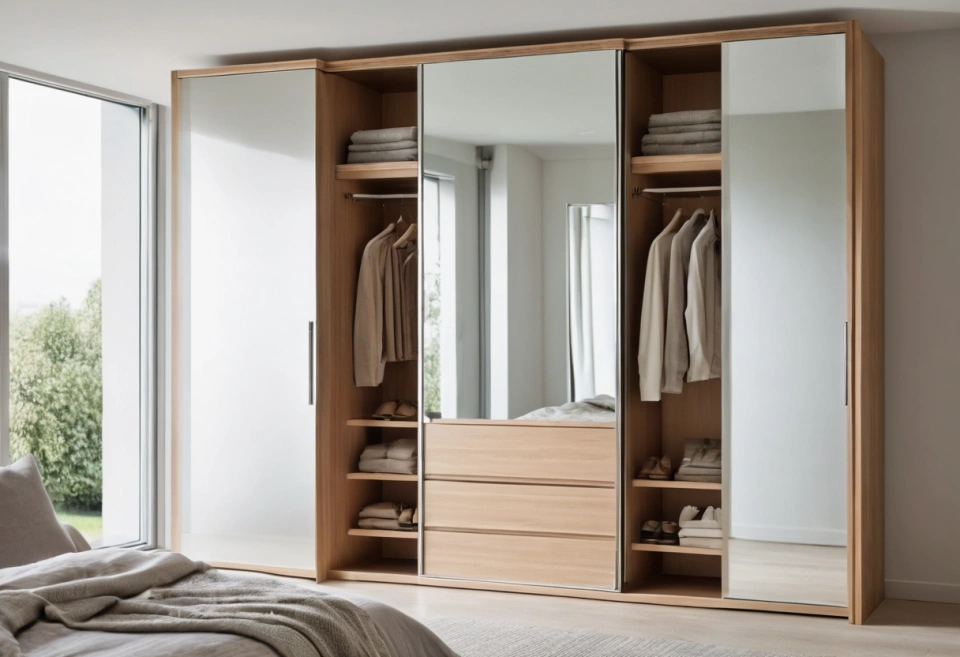
A walk-in wardrobe from a spare corner in a UAE apartment
Most apartments have a corner that could hold a dressing room. The trick is surrendering less floor than you expect, and keeping air moving behind the doors.
This is for anyone in a UAE apartment with a box room, an awkward alcove or a bedroom corner doing nothing much, who would rather dress inside a small walk-in wardrobe than fight a run of hinged doors. It covers how much floor you genuinely need, where sliding doors help and where they quietly cost you, what to do with mirrors, and the ventilation problem that decides whether your leather survives the summer.
Start with the room you already have
The best candidates are rarely the obvious ones. A box room too narrow for a bed, the dead end of an L-shaped bedroom, the stretch behind a door that never opens fully: these convert well because they already have three walls and a ceiling. A corner carved out of a bedroom needs two new partitions, cheaper than it sounds if you keep them simple and stop them a hand’s width short of the ceiling line, then close the gap with a fascia.
Before drawing anything, stand in the space wearing the bulkiest thing you own. A winter coat, an abaya with volume, a padded jacket brought back from somewhere colder. Turn around. Reach up as if for a shelf. If your elbows hit both sides at once, the space is a wardrobe with a door, not a walk-in. That is fine, but plan it as one. A true walk-in lets you step inside and close the door behind you without touching the clothes.
Think about what leaves the room, too. A spare corner often holds the ironing board, the suitcase, the vacuum. Those need a home elsewhere before the joinery arrives, or they will creep back onto the floor of your new dressing room within weeks.
Clearances, described the way you actually use them
Numbers on a plan mean little until you move through the space. Here is the useful version.
Hanging clothes take roughly a forearm’s depth from the wall, measured from the rail to the front of the fullest garment. Shoulders overlap; suits and structured coats need more room than shirts. Behind that, you need a standing lane wide enough to face the rail squarely and lift your arms without brushing the opposite side. Allow a little more if you want to bend to a low drawer while another person passes.
A few things worth checking before anything is built:
- Stand at the deepest point and reach the highest shelf flat-footed. Anything above that is seasonal storage, reached with a step, not daily use.
- Open every drawer and door in the plan fully. A drawer that hits a partition is a drawer you will stop using.
- Leave a palm’s width between the top of hanging clothes and the shelf above, so garments slide off the rail without dragging.
- Check the floor for level. Apartment slabs are rarely as flat as they look, and a tall unit will tell you immediately.
If the lane feels tight, shorten the run rather than narrowing it. Storage you cannot reach is not storage.
Sliding doors earn their place, with one honest caveat
In a small apartment, sliding doors are usually right. Hinged doors need a swing arc, and that arc eats the very floor you were trying to reclaim. Sliders run in their own plane, so circulation outside stays clear, which matters when the wardrobe faces a bed or sits along a corridor.
The caveat: a two-panel slider only ever reveals half the opening. You cannot see your whole wardrobe at once, and you will spend a moment each morning shuffling panels. Three or four narrower panels give a wider view but more frame and more visual clutter. Decide which annoyance you prefer.
Details that separate a good slider from an irritating one: a top-hung track with a floor guide rather than a bottom roller channel, because the channel collects dust and sand and eventually grinds. Soft-close in both directions. A recessed pull or a full-height edge handle you can find without looking. And check the overlap between panels: a slim overlap is where dust gets in and where you glimpse the contents through a gap all day.
If the opening is generous and the room outside is not, consider a single wide slider on a pocket track. If the opening is narrow, curtains of heavy fabric are unglamorous and work perfectly, with the advantage that they let air through.
Mirrors, placed for light rather than vanity
A mirrored door does two jobs in a small apartment: it saves the wall space a separate mirror would take, and it bounces daylight deeper into the room. Put the mirror on the panel you open most, so the reflection is useful when you are half dressed rather than hidden behind the fixed leaf.
Full-length matters more than width. You need to see hem to head in one glance, standing a normal pace back, which means the mirror should start near the floor and run high enough to catch the top of your head at that distance. A mirror set too high shows your torso and nothing else.
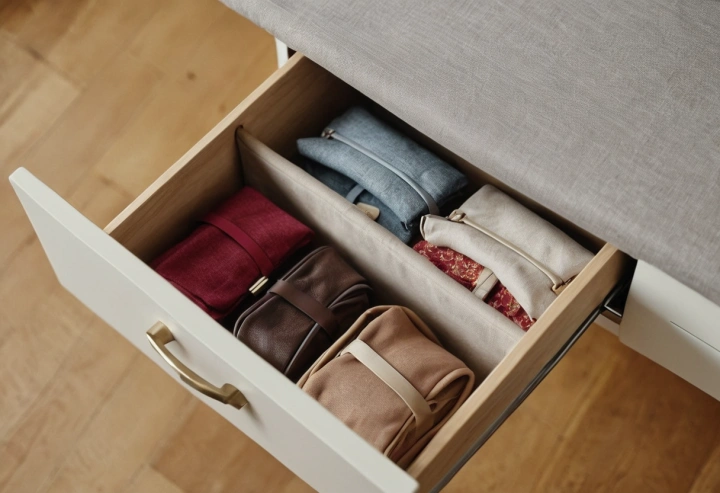
Avoid placing mirrored faces directly opposite the only window unless you enjoy glare at certain hours. Angling them towards a side wall gives softer, more usable light. Inside the enclosure, a small mirror on the return wall helps with jewellery and collars, though a lit dressing table does it better. For the small things that live beside the mirror, our notes on organising the dressing table drawer cover wallets, pouches and jewellery without letting them colonise every surface.
One practical warning: mirrored panels are heavy. Confirm the track and the ceiling fixing can carry them before you fall for the look.
Ventilation is the part people skip
A sealed box in a humid climate is how leather grows a bloom and wool picks up a smell. Air conditioning dries the air in the rooms you occupy, but a closed wardrobe with no gaps sits outside that circulation, and moisture from the building, from nearby bathrooms and from clothes put away slightly damp accumulates quietly.
Build the airflow in. Leave a gap at the top of the enclosure and another at the bottom, so air can drift through rather than sit. Louvred panels or a discreet grille in the fascia do the same job more neatly. Keep the back panel a finger’s width off the external wall if that wall is prone to condensation, and never store anything against a surface that feels cool and damp to the touch.
Then add the habits. Leave the doors open for a while each morning, ideally while the air conditioning is running. Do not return clothes straight from a humid evening outdoors into a closed enclosure; give them an hour on a hook first. A rechargeable dehumidifier or a few moisture absorbers inside help, provided you renew them. Charcoal sachets manage odour, not moisture, and are no substitute.
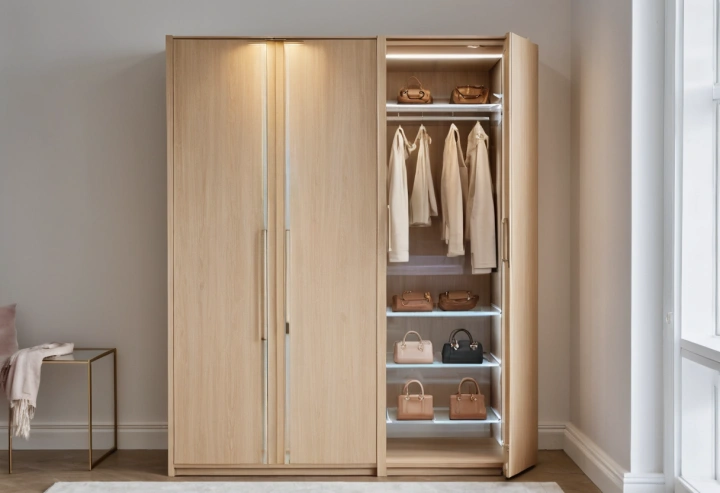
For bags specifically, this is where the enclosure earns or loses its keep. Dust bags rather than plastic, shelves rather than hooks, and enough space that nothing is compressed. Our guide to storing a handbag collection at home goes through stuffing, shelving and spacing in detail, and it applies just as well in a converted corner as in a large dressing room.
Light, power and the small comforts
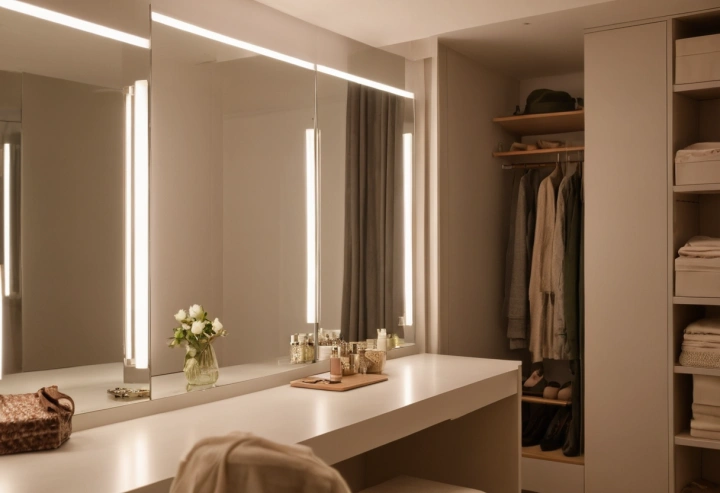
You cannot dress properly under a single ceiling downlight aimed at the back of your own head. Put light inside the enclosure, along the rail or under each shelf, switched by the door opening. Warm-neutral light reads colours honestly; very cool light makes navy look black and beige look grey.
Plan a socket if you can, even one. It runs a steamer, charges a dehumidifier, powers a small fan on still days. Retrofitting power into finished joinery is a mess you can avoid with an early conversation.
Give the everyday things a landing place at the entrance: a shallow tray for keys and cards, a hook for the bag you carry daily, a shelf at hip height allowed to be temporarily messy. Without one, the floor becomes the surface.
Your next step
Take a tape and a phone tonight. Measure the candidate corner, note where the window and the air conditioning vent sit, and photograph the space from the doorway. Then hang your bulkiest coat on a temporary rail in that spot and live with it for a few days. If you can move around it comfortably, sketch the layout with the lane marked first and the storage fitted into what remains. If you cannot, you have learned something cheaply, and a well-planned run of wardrobes with sliding doors will serve you better than a walk-in you have to squeeze into.
- Words
- Rail & Shelf editors
- Published
- Section
- Dressing Rooms
- Standards
- Editorial policy · Corrections