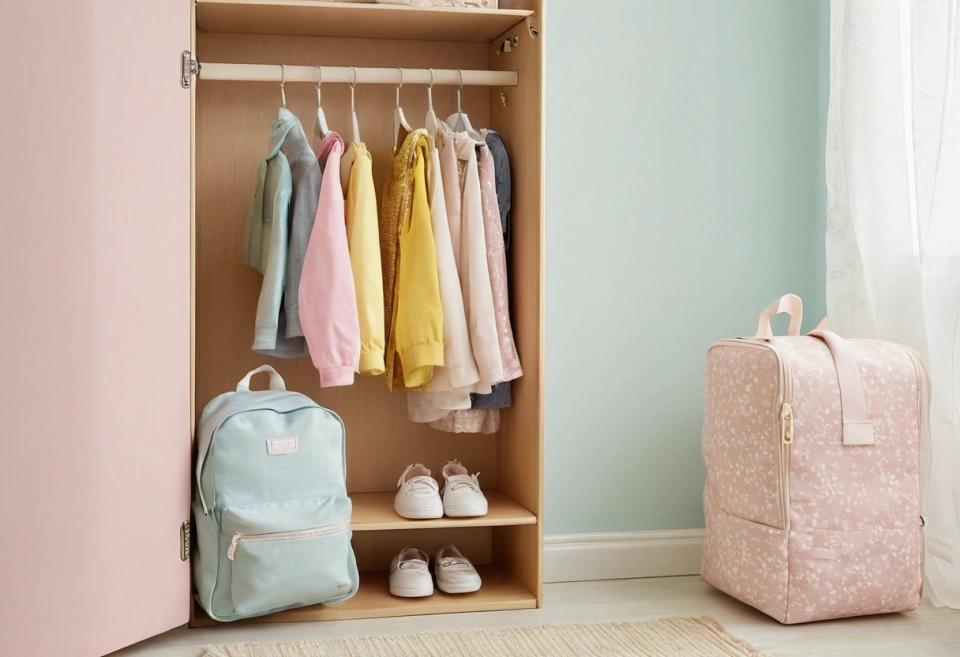
A children's wardrobe that grows with the child
Most children's wardrobes are built at adult height and then defended by adults. A few movable parts turn them into something a child can run.
This is for parents in a UAE apartment or villa tired of being the only person who knows where the school socks live. It covers a wardrobe that can be rearranged as a child grows: rails that move, hooks at a height a child can reach, boxes that say what is inside, a proper home for the school bag, and a slow handover of responsibility so the system still works when the child is taller than the furniture.
Build the wardrobe in two heights
The most useful change is a second rail. Most fitted wardrobes arrive with one rail set for adult coats and dresses, which leaves a child staring at a hemline. Put a lower rail beneath it, roughly at the height of the child’s outstretched hand, and hang the everyday things there: school shirts, shorts, the cardigan that goes on and off four times a day. The upper rail takes what is not needed daily: occasion clothes, last season’s coat, the swim kit waiting for a holiday.
If the carcass has rows of shelf pin holes down the sides, you already have an adjustable system. Shelf pins and a rail bracket let you raise the lower rail a hand’s width every year or so without drilling anything new. If the sides are plain, a freestanding rail inside the wardrobe cavity does the same job and lifts out when the child wants full length hanging instead.
Leave a clear gap under the low rail. Shoes lined up on the floor of the wardrobe are easier to find than shoes in a box on a high shelf, and a child who can see both shoes will put on both shoes. In a humid coastal flat, keep that gap airy rather than packing it with bags; leather school shoes need to dry out between wears, and a closed pile is where damp smells start.
What hangs and what folds
Hang anything that creases or that a child needs to grab quickly. Fold the rest into shallow stacks, no more than a few items deep, because a tall stack collapses the moment someone pulls from the bottom. T-shirts, pyjamas and leggings fold well. Knitwear should never hang, since shoulders stretch on hangers. Use child sized hangers, thin ones with a slight grip, so clothes do not slide off and the rail holds more without becoming a thicket.
Hooks a child can actually reach
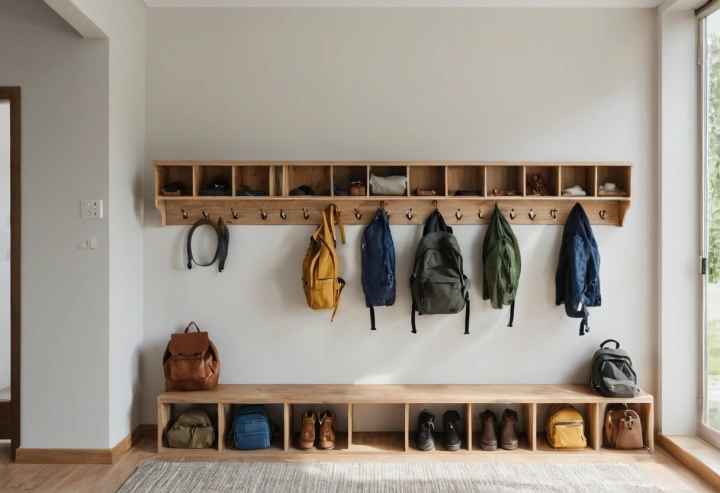
A hook is only useful if the child can get something onto it without help. Set a row low, around shoulder height for the child rather than the adult, and space the hooks generously so a dressing gown and a hoodie are not fighting for the same peg. Inside the wardrobe door is a good spot, or on the side panel if the wardrobe stands against a wall.
Give each hook a fixed job. One for the dressing gown, one for tomorrow’s outfit if you lay clothes out the night before, one for the bag that comes indoors. Fixed jobs remove the daily negotiation about where things go. When the child grows, move the whole row up rather than adding new hooks at odd heights, or you end up with a wall of pegs nobody uses.
Check what the hooks are screwed into. Plasterboard alone will not hold a loaded bag for long, so fix into a stud or use proper plasterboard fixings rated for the weight. A child will eventually hang off a hook, whatever you say.
Boxes, labels and the things that migrate
Small items defeat children’s wardrobes. Socks, hair clips, swimming goggles, the single glove, the football stickers. Open shelves turn these into a drift; boxes contain them. Fabric boxes with soft sides are kinder to small hands than heavy lidded crates, and they slide onto a shelf without scratching it.
Keep boxes at the child’s level, on the lowest shelf or in the base of the wardrobe. A box a child cannot reach is a box an adult empties. Choose boxes light enough to carry when full, and shallow enough that nothing hides at the bottom.
Label the front, not the lid, because lids come off and fronts do not. For a child who cannot read yet, draw or print a picture alongside the word: a sock, a ball, a swimsuit. The picture does the work now and the word does it later, a quiet bonus. For an older child, words alone are fine, and letting them write the labels themselves buys surprising amounts of cooperation.
A short list of what usually earns its own box:
- Socks and underwear, kept together so mornings involve one stop rather than three.
- Swim things, goggles and a hat, dried fully before they go back in.
- Sports kit for whatever the current season is, reviewed at the end of that season.
- Craft and small treasures, with an agreed limit so the box closes.
Rotate rather than accumulate. At the change of season, pull out what no longer fits and pass it on the same week. Clothes stored in a sealed box through a UAE summer in an uncooled room can come out musty, so use breathable fabric containers, keep them off exterior walls that sweat with condensation from air conditioning, and never store anything still faintly damp.
The school bag needs its own address
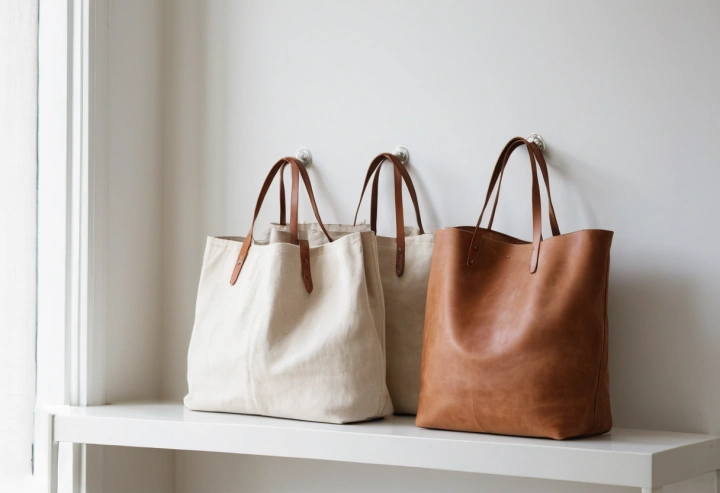
A school bag left on the bedroom floor becomes a chair, then a shelf, then a lost permission slip. Give it one hook near the door the family actually uses, at a height the child can manage, and make that the only place it lives. Empty it there, hang it there, pack it there. Our notes on a family drop zone for school and sports bags cover the entry side of this in more detail, including how many hooks a household really needs.
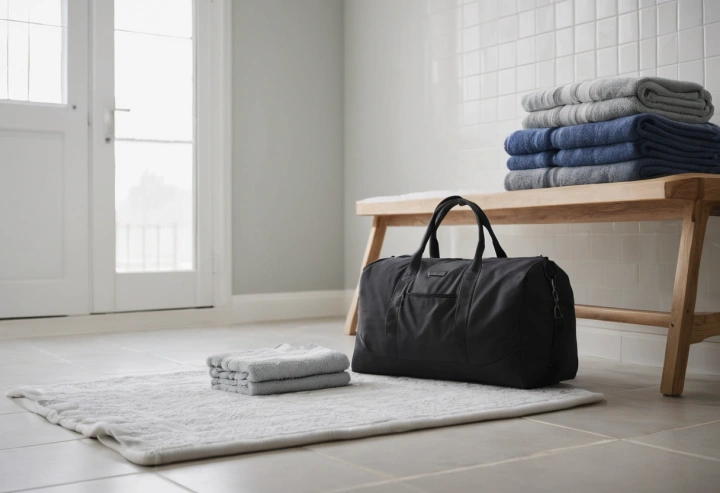
Inside the wardrobe, reserve a shallow tray or box for the paperwork and the small extras: lunch box lid, water bottle cap, the reading record. If sports kit travels in a separate bag, treat it as a wet item rather than a wardrobe item. Damp kit belongs somewhere ventilated, not shut in with clean shirts, and the routine in our piece on ventilating gym bags and damp kit applies just as well to a nine year old’s football holdall.
Backpacks last longer hung by their loop than crammed onto a shelf, since compression creases the padded back panel and flattens the base. Brush out crumbs weekly, unzip the main compartment overnight now and then, and wash according to the label rather than by guesswork.
Handing over responsibility, one drawer at a time
A wardrobe a child cannot run is a wardrobe an adult runs forever. The handover works best gradually and with real authority attached. Start with a single drawer the child owns completely: they choose what goes in, they arrange it, and you do not tidy it. It will look wrong to you. That is the point. Ownership is what makes the rest of the system stick.
Once that drawer stays roughly functional, add the next one. Then the low rail. Keep the high rail and the seasonal boxes as adult territory for longer, since those involve judgement about fit and weather rather than daily habit.
Give the child a reset ritual rather than a lecture. Five minutes before bath time, everything off the floor and back on its hook or in its box. Make it timed and predictable, not a punishment triggered by mess. Older children can take on the seasonal sort themselves, with you nearby to catch the sentimental items that will never be worn again but cannot be thrown away. Those get one box, clearly named, with a limit.
Expect the system to lapse during exam weeks and holidays. It should be easy enough to restart in an afternoon, which is the real test of any storage plan.
Where to start this weekend
Pick the lowest reachable shelf and the space beneath the existing rail. Move everyday clothes down to a new low rail, put socks and underwear in one labelled box within reach, and fix a single hook near the door for the school bag. Nothing else needs to change on day one.
Then hand over one drawer and leave it alone for a fortnight. Watch what the child reaches for and what they ignore, and adjust the heights rather than the rules. If you are planning the wider room at the same time, our guide to zoning a dressing room for hanging, folding and accessories sets out the same logic at adult scale, worth reading before you buy any fitted joinery you cannot move later.
- Words
- Rail & Shelf editors
- Published
- Section
- Family Storage
- Standards
- Editorial policy · Corrections