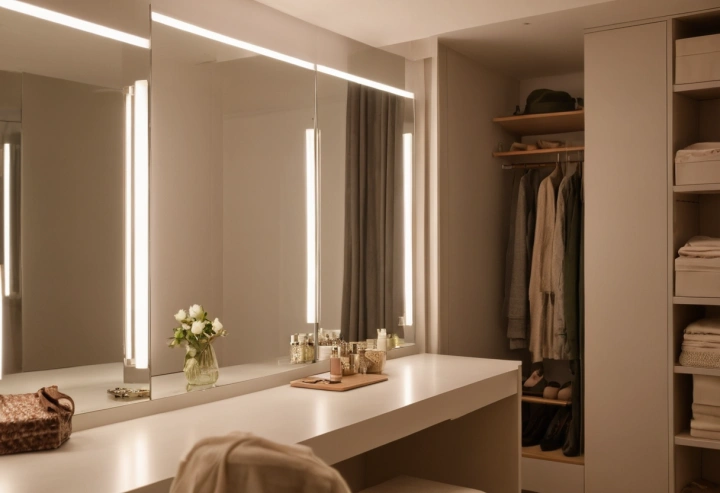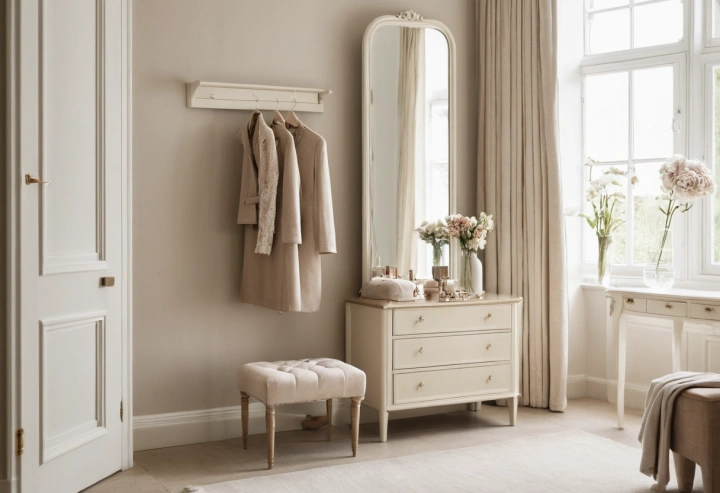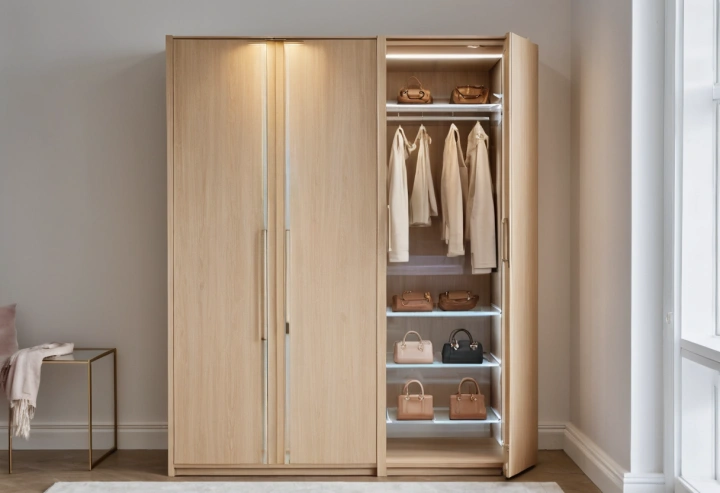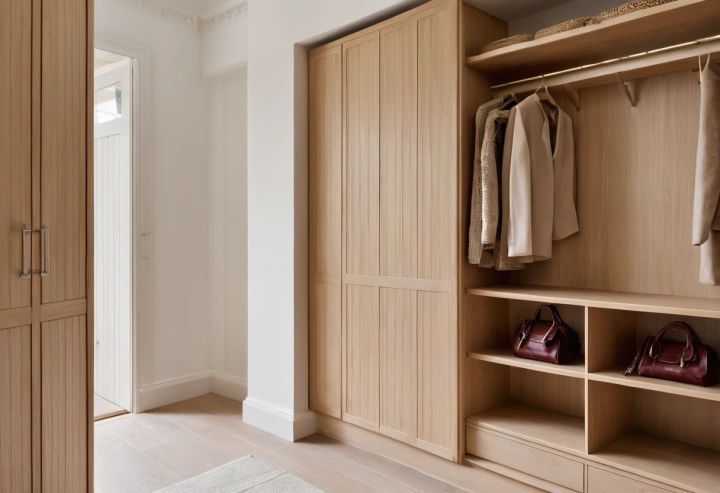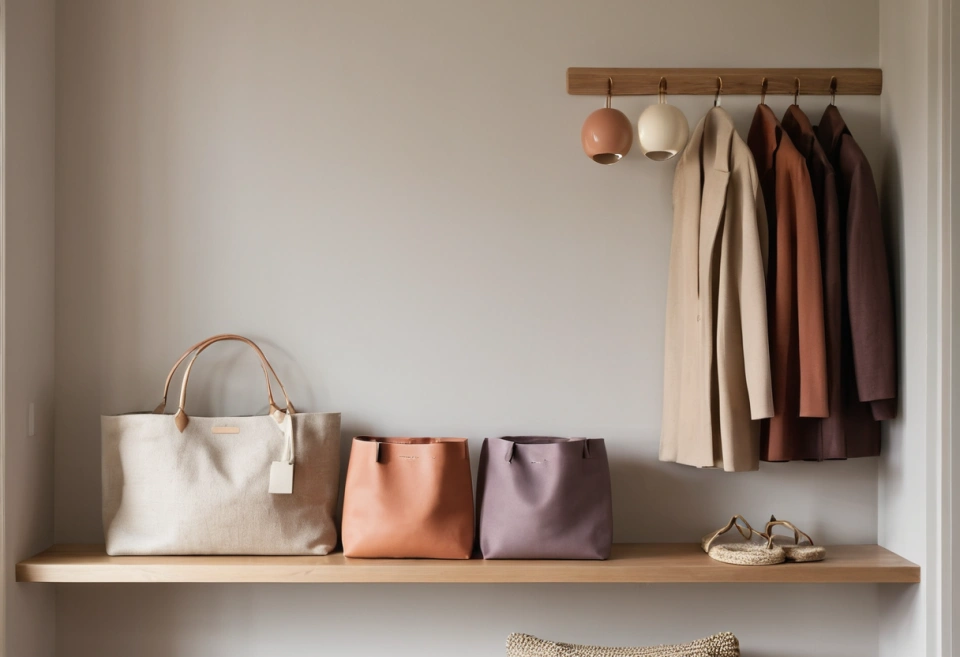
Styling a dressing room with bags on show
A few good bags can carry a whole wall. The trick is treating them as objects in a room rather than stock on a shelf: ordered by colour, spaced to breathe, and changed before the arrangement goes stale.
This is for anyone who owns a handful of bags worth looking at and wants them to work as part of the room rather than sit behind a door. It covers how to order them by colour, how much space to leave, when to swap the arrangement, and where display quietly turns into clutter. If you came here hoping for tips on carrying a fashionable tote, most of that advice rests on the same decisions: which tote you reach for, what condition it stays in, and whether it looks intentional or apologetic when you set it down.
Start with the wall, not the bags
Before anything moves, decide what the display is doing. A dressing room usually has one surface that behaves like a picture: a run of open shelving, a shallow niche, the top of a chest of drawers under a mirror. That is the stage. Everything else is storage.
The mistake is letting the stage grow. Once bags appear on three separate walls, none reads as chosen, and the room starts to feel like a stockroom with good lighting. Pick one zone, keep it at eye level or just above, and accept that the rest of the collection lives elsewhere. Our complete guide to storing a handbag collection at home covers the closed-storage side of that split, including what to do with the pieces you love but rarely carry.
Height matters more than people expect. A shelf slightly above eye level shows the tops and handles of bags, flattering for structured shapes and unkind to slouchy ones. A shelf at chest height shows the front panel, which suits flat, graphic designs and printed canvas. Look at your own bags from both angles before fixing anything.
Colour order that holds up in daylight
Colour ordering is the fastest way to make a mixed collection look deliberate. It works because the eye stops counting objects and starts reading a gradient.
Sort everything into three families first: warm (tan, camel, rust, cream with a yellow cast), cool (grey, navy, black, taupe, anything with a blue undertone) and true neutrals (chalk white, stone, chocolate). Then arrange within each family from palest to deepest, left to right, the way you would read a line of text. Keep families on separate shelves if you can. A single shelf that jumps from ivory to oxblood to sky blue will always look busy, however carefully spaced.
Two refinements make a real difference. First, let hardware join the conversation: gold-toned fittings sit comfortably in the warm half, silver and gunmetal in the cool. Second, treat texture as a colour of its own. Suede, grained leather, smooth calfskin and woven raffia all reflect light differently, so a shelf of identical mid-browns can still look flat. Alternate matte and sheen and the row gains rhythm without gaining noise.
Daylight in the UAE is strong and slightly warm, and it shifts through the day. Check your arrangement in the morning and again in late afternoon before committing. A pairing that looks harmonious at noon can turn muddy under a warm lamp at night.
Symmetry, odd numbers and the space between
Symmetry is a tool, not a rule. A balanced pair either side of a lamp or a tall vase gives a niche a centre and makes the whole thing feel architectural. Three bags in a stepped line, tallest at one end, give movement. Both work. What does not work is four bags of similar height in an even row, which reads as inventory.
Odd numbers help because they create a middle. With three objects, the eye finds the centre and rests. With five, it does the same but needs more room. On a modest shelf, three is usually the honest maximum.
Negative space is the part most people skip. Leave roughly a hand’s width between bags, and at least that much again at each end of the shelf. Empty shelf is not wasted shelf; it is what makes the bags visible as shapes. If you cannot fit a group with breathing room, remove one item rather than compressing the gaps. A crowded display of beautiful things still looks crowded.
A short checklist before you step back:
- Handles settled the same way, either all upright or all folded forward, not a mixture.
- Straps tucked inside or coiled loosely beside the bag, never trailing over the shelf edge.
- Nothing stacked on top of anything else.
- One non-bag object per shelf at most: a lamp, a bowl, a small stack of books.
- Front edges aligned to an invisible line so the row reads as one gesture.
Rotating what is on show
A display that never changes stops being noticed, and the bags quietly gather dust and light exposure. Rotation solves both problems at once.
Set a loose rhythm of a few weeks. Swap two or three pieces, keep the colour logic intact, and put the retired bags away properly rather than on a chair. Seasonal rotation is the easiest version: lighter canvas and raffia forward in the hotter months, deeper leathers and suede when the weather softens. Suede in particular dislikes long spells on an open shelf, so give it a shorter turn.
Rotation also keeps your carrying habits honest. If the same tote has been on the display shelf for months and never leaves the house, it is decoration, not a bag. Either use it or store it well and let something else have the light.
Everyday bags need different treatment. The tote you actually carry should not live on the styled shelf, because it will be grabbed and dropped and the arrangement will collapse daily. Give it a fixed landing place near the door or on a hook inside the wardrobe instead. We have written separately about giving the bag you use every day a proper home, and it is the single change that most improves how a dressing room holds together.
Totes on display without losing their shape
Totes are the hardest bags to style because they are the least rigid. A soft canvas or unlined leather tote left empty on a shelf folds in on itself within days, and the crease at the base becomes permanent.
Fill them lightly with acid-free tissue or a clean cotton pillow insert, enough to hold the body upright without stretching the seams. Never use newspaper; the ink transfers. Stand structured totes upright with handles supported so they do not drag the top edge down. Slouchy styles often look better sitting slightly relaxed, but still supported from inside. Our notes on keeping soft and structured totes in shape go into the filling and support detail.
For the fashion side of the question, the honest answer from a storage point of view is this: a tote looks current when it looks cared for. Clean corners, unbroken handles, a base that holds its line. The most photogenic bag in the room is rarely the newest one; it is the one that has been kept properly. Trend chasing ages a display faster than any colour choice.
Where display becomes clutter, and what to do about it
Clutter arrives gradually. A shopping bag left on the shelf. A dust bag draped over a corner. Two small pouches parked in front of a tote because there was nowhere else. None of these decisions is wrong on its own; together they dissolve the arrangement.
Hold a simple line: the display shelf carries bags and nothing that belongs to a daily routine. Keys, receipts, sunglasses and wallets go in a drawer or a tray, not on the stage. Dust bags live folded in a basket or hung inside the wardrobe. Small leather goods belong in a lined drawer where they can be seen at a glance rather than piled on open shelving.
Then there is the climate. Airborne dust in the UAE is fine and persistent, and it settles into grain and stitching. Open display means weekly attention with a soft brush or dry cloth, and a genuine commitment to keeping bags out of direct sun, which fades and dries leather faster than almost anything else. If your dressing room takes strong afternoon light, or you would rather not dust every week, glass-fronted cabinetry gives you most of the visual pleasure with far less exposure. The comparison between open shelving and glass-front protection is worth reading before you commit to a wall of open cubes.
Humidity is the quieter risk. Air-conditioned rooms cycle between dry and damp, and leather prefers steadiness. Keep display shelving away from vents and off external walls that heat up during the day, and give stored bags airflow rather than sealed plastic.
Your next step
Clear one shelf completely. Wipe it, then bring back only three bags from the same colour family, palest to deepest, with a hand’s width between them and space at both ends. Add one object that is not a bag. Live with it for a week.
If the shelf still looks right after seven days of ordinary mornings, you have found your display zone and your rules. Put the rest of the collection away properly, mark a rough date a few weeks ahead to rotate, and give your everyday tote a hook of its own. That is the whole method: fewer things, better spaced, changed before they go stale.
- Words
- Rail & Shelf editors
- Published
- Section
- Dressing Rooms
- Standards
- Editorial policy · Corrections