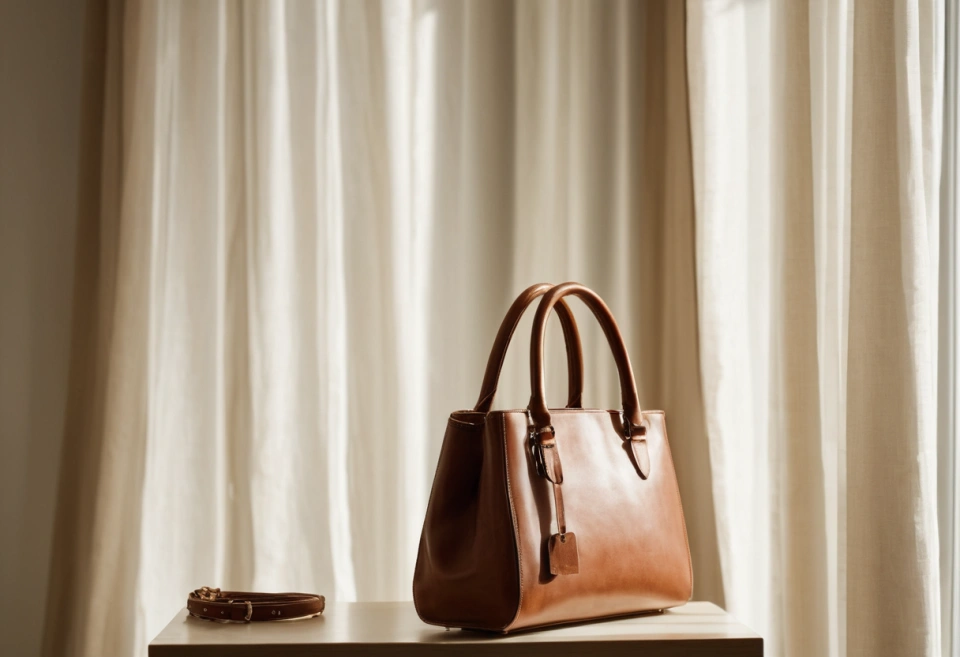
Sun, heat and dry air: keeping good leather bags well at home
A polished bag on an open shelf looks wonderful and ages fast. Here is how to place, cover and rotate a small collection of good leather so the colour stays even and the handles stay supple.
Who this is for
This is for anyone in a UAE apartment or villa who owns a handful of good leather bags and wants them to look the same in a few years as they do now. It covers where a bag sits relative to the window, what glass does and does not filter, why a closed cupboard beats an open shelf, how to rotate a small collection so nothing dries out unnoticed, and what a professional leather care service can realistically repair. If you came here looking for stylish bags to carry around Dubai, the useful half of that question happens at home: a beautiful bag stays beautiful because of where it sleeps.
The window is the real hazard
Most damage to a bag at home is slow, uneven and caused by light. A shelf beside a west-facing window takes hours of strong afternoon sun, and the side of the bag facing the glass takes all of it. Over a season the front panel lightens, the gusset behind it does not, and the difference shows only when you turn the bag around. Tan and pale leathers show it first. Deep colours fade too, just less obviously, often towards a dull grey rather than a lighter version of themselves.
Ordinary window glass blocks some ultraviolet light but lets plenty through, along with the visible light and infrared that heat things up. Sheer curtains help by scattering the beam, which makes them worth having, but they are not a shield. A bag left on a console in a bright room is still being quietly bleached.
Heat matters separately from light. A closed balcony door, a car boot, a shelf above a radiator or a spot near an appliance can push the temperature well past anything the leather was finished for. Warmth drives out the oils and moisture that keep hide flexible, and repeated heating and cooling works the finish until it crazes. Patent and coated leathers can also turn tacky in sustained heat, and once a surface has gone sticky it attracts dust that no brush will lift cleanly.
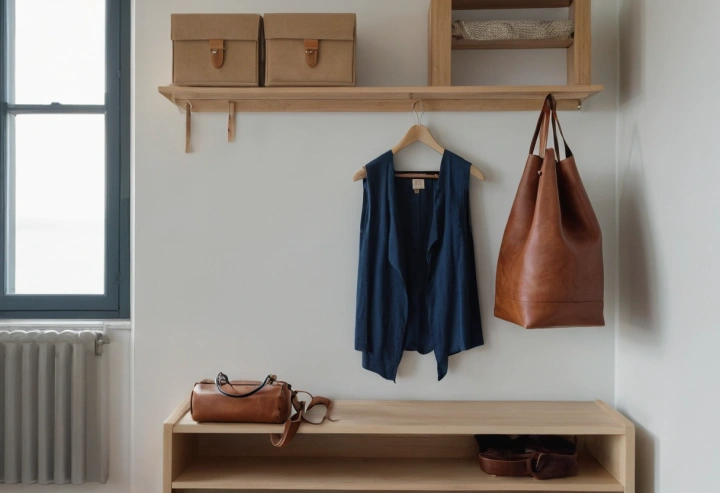
The practical rule: nothing made of leather lives within reach of direct sun, and nothing lives on top of anything that gets warm.
Closed cabinets, with room to breathe
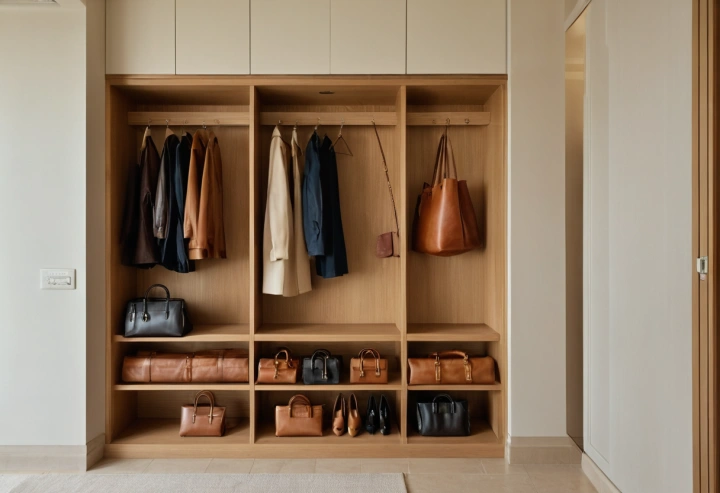
A closed cabinet on an interior wall is the steadiest place in most homes. No light reaches the leather, temperature swings are gentler, and dust settles on the door rather than on the grain. Wardrobes built against an exterior wall run warmer through the day, so if there is a choice, take the wall that faces another room.
Darkness is not the same as suffocation. Leather needs some air movement, so avoid sealing bags in plastic bins, vacuum bags or the polythene they sometimes arrive in. Cotton dust bags are the right answer: they block light, let the leather breathe and stop hardware pressing marks into a neighbouring bag. Leave a hand’s width between bags so nothing is compressed, and never stack a heavy tote on a soft shoulder bag.
A few habits that cost nothing:
- Keep bags off the floor and away from the wardrobe base, where cool air and damp collect.
- Stand structured bags upright, stuffed lightly so the base does not crease.
- Store handles and chains inside the bag or laid flat, not hooked over a rail where they hold a bend.
- Open the cabinet doors for a while on a dry day, ideally when the air conditioning has been off.
- Check the whole shelf every few weeks rather than only the bag you are reaching for.
Silica sachets are a sensible precaution in coastal months, tucked beside the bags rather than pressed against the leather. For the wider layout question, our complete guide to storing a handbag collection at home covers shelving depths, hanging versus standing and how to plan a wardrobe around a growing set of bags.
Air conditioning dries more than it cools
Air conditioning removes moisture from the air, which is exactly what makes a UAE summer bearable indoors and exactly what leather dislikes. Months of dry, cool air draw moisture out of hide slowly. The first signs are subtle: a slightly papery feel, corners that hold a fold, handles that squeak faintly when flexed. Left long enough, the grain cracks along the stress lines and that damage is permanent.
Do not point a vent at a wardrobe or an open bag shelf. Cold, dry air blowing directly onto leather is worse than the same air moving gently around a room. If a dressing room has its own supply, angle the louvres away from the storage wall.
Feed the leather sparingly. A little plain, unfragranced leather conditioner, worked in with a soft cloth and buffed after it has settled, restores suppleness. Twice a year suits most bags kept indoors, with a little more attention to handles and edges, which flex and dry fastest. Test any product on the base or an inside seam first, and expect suede, nubuck, exotic skins and heavily finished patent to need their own approach rather than a general cream. Over-conditioning is a genuine mistake: saturated leather goes slack, loses its shape and turns dull.
Humidity swings matter as much as dryness. Coming home from a coastal evening with a bag that has absorbed damp, then putting it straight into a sealed cupboard, invites mould. Let it stand in a dry room first. Our note on looking after a shoulder bag through the humid coastal months goes into that in more detail.
Rotation is a care routine, not a fashion one
A bag carried every day wears evenly and gets noticed. A bag stored for a year wears oddly and gets forgotten. Rotation solves both problems.
Bring the whole collection into use across a season rather than working through two favourites and leaving the rest dormant. Every time a bag comes out, look at it in daylight: check the base corners, the handle attachments, the piping and the underside of the flap. Small problems are cheap to fix and large ones are not. Empty pockets, shake out crumbs, wipe the lining if it is fabric, and let the bag air before it goes back into its dust bag.
Restuff after use. Acid-free tissue or a proper bag insert holds the shape without straining the seams, and should be replaced when it goes limp or damp. Newspaper transfers ink and is best avoided entirely. For boxy shapes that collapse at the sides, we have written separately about keeping structured bags in shape with paper, pillows and inserts.
Small leather goods deserve the same discipline. Wallets and card holders left in a hot drawer stiffen and warp just as bags do, and the argument for organising and rotating small leather goods in a drawer is the same one made here.
What a leather care service can and cannot do
A good professional service is worth knowing about, provided expectations are realistic.
What it can generally do: clean surface grime and old product build-up, recondition dried leather, treat some water and salt marks, tidy scuffed edges, replace edge paint, restitch opened seams, repair or replace hardware, refresh linings, and correct dye transfer on sturdy finished leathers with careful recolouring.
What it cannot do: reverse ultraviolet fading evenly across a whole bag, un-crack leather that has split along a fold, remove deep oil stains that have travelled into the fibre, restore a stretched handle to its original length, or rebuild a base that has collapsed and creased through poor storage. Colour can sometimes be reapplied, but matching a faded panel to its neighbours is difficult and the result rarely looks factory-fresh. Suede and delicate exotic skins limit the options further.
Ask what the treatment involves before agreeing to it, ask whether the finish will change, and be wary of anyone promising a full restoration of sun damage. Prevention costs a dust bag and a shelf. Correction costs far more and delivers less.
Your next step
Walk to the window nearest your bags and stand where they sit at the hour the sun is strongest. If light lands on them, move them today: an interior wall, a closed cabinet, cotton dust bags, a hand’s width of space around each one. Then take everything out, examine each base and handle in daylight, and note anything that needs attention while it is still small. That single afternoon does more for a collection than any product you can buy.
- Words
- Rail & Shelf editors
- Published
- Section
- Leather & Care
- Standards
- Editorial policy · Corrections