Accessory storage for everyone in the house
Small accessories are the first things to vanish into a wardrobe and the last to be found. Here is how to give each category a home that suits the person using it.
This is for households where more than one person owns good things and nobody can find them. A silk scarf ends up knotted round a hanger. A spare shoulder strap lives at the bottom of a tote it no longer belongs to. Bag charms migrate between bags until half are missing. The answer is not a bigger wardrobe. It is a small set of decisions about hanging, rolling and boxing, applied consistently across everyone in the house.
Why accessories go astray
Bags have presence. They occupy shelf space and demand attention. Accessories do not. A pouch collapses, a strap coils into something resembling nothing at all, and a charm the size of a walnut slides behind a shelf lip. Because these items are small, they get pushed into whatever gap exists, usually a gap belonging to something else.
The second problem is shared ownership. In many Dubai apartments and villas, one dressing room serves two people, or a parent’s wardrobe absorbs a teenager’s overflow. Shared drawers become unclaimed drawers. Nobody feels responsible for tidying a space that is not clearly theirs.
The fix has two parts: a storage method matched to the material, and a boundary matched to the person. Both are cheap. Neither requires new joinery.
Scarves: hang the delicate ones, roll the sturdy ones
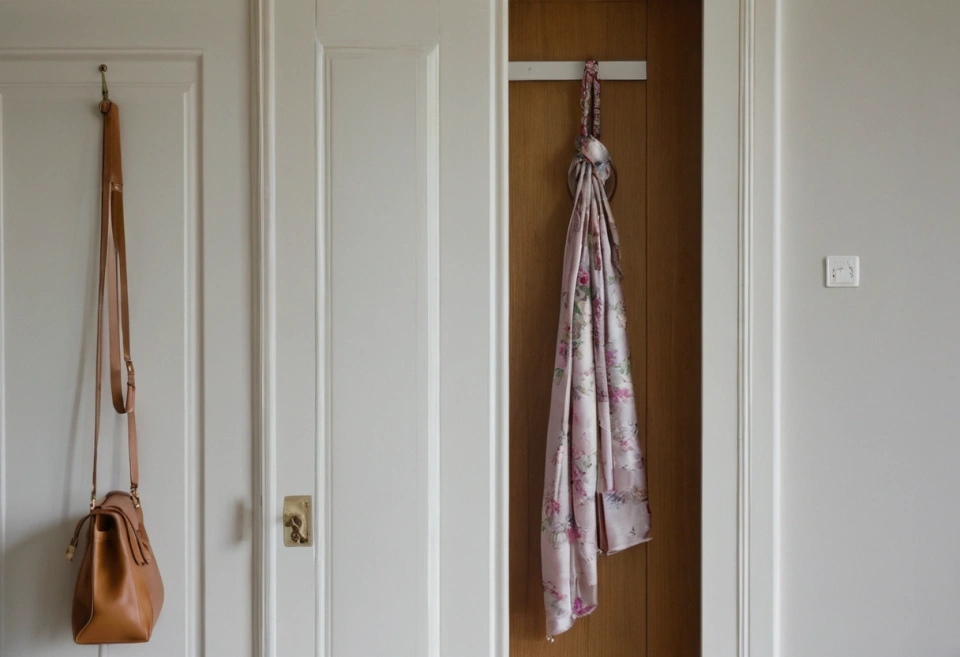
Silk resents being creased. A hard fold left in place for months becomes a line that will not press out cleanly, and pressing silk at home is a risk most people would rather avoid. Hang silk scarves instead, draped once over a padded or flocked rail so the fabric bears no point load. A slim rail fixed inside a wardrobe door works well, provided the door closes without the scarves brushing the shelf edge. Give each scarf a hand’s width of rail so you can lift one out without dragging its neighbour.
Cashmere and wool behave differently. They stretch under their own weight if hung for long periods, so roll them loosely and lay them in a shallow drawer or an open box, standing on end like files rather than stacked flat. Rolling avoids the crease; standing on end avoids the crushing. If a wool scarf has been worn heavily, air it before it goes back in the box.
Cotton and linen scarves are forgiving. Fold them, stack them, do not overthink them. Keep them apart from the silk so that retrieving an everyday cotton square does not disturb the pieces you are protecting.
One seasonal note for the UAE: air conditioning runs hard for much of the year and indoor air turns dry, which suits leather and metal but does nothing for fabric stored damp. Never box a scarf worn outside in August humidity without letting it dry first in a shaded, aired room.
Spare straps: coil, label, box
A detachable strap is the most orphaned object in any bag collection. It arrives with the bag, gets swapped for a shorter one, then spends years loose in a drawer.
Coil each strap in a loose circle, following the direction the leather already wants to take. Never knot it and never wind it tightly round itself: a tight coil sets a curl into the leather that shows when the strap hangs. Fasten the buckle before coiling so the hardware sits inside the circle rather than pressing against the strap face.
Store the coils flat in a shallow box, side by side, not piled. A fabric-lined tray or a plain box with a soft cloth base is enough. Write the bag name on a small card and tuck it beside the coil. This sounds fussy until the day you need the right strap in a hurry, when it becomes the most useful habit in the dressing room.
Webbing and canvas straps can be rolled more firmly and stood upright in a deeper box. Keep leather and metal away from anything damp, and both out of direct sun. A shelf inside a closed wardrobe beats an open ledge near a window every time.
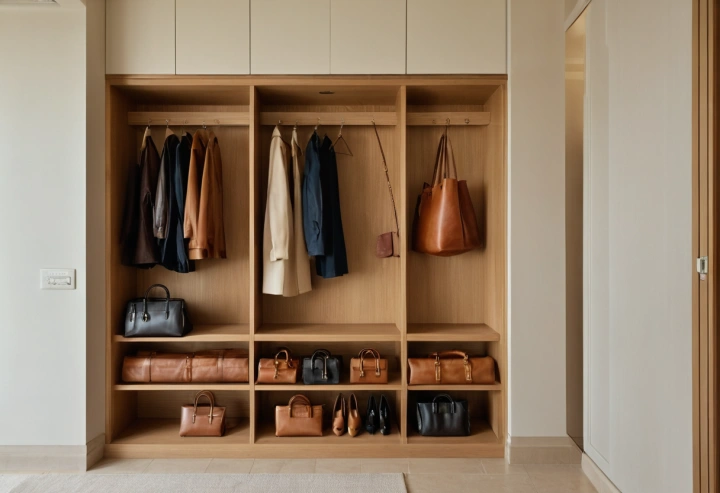
If your bag collection is still finding its feet, our complete guide to storing a handbag collection at home covers shelving, filling and dust covers, and it makes sense to settle that before you organise the straps.
Bag charms and small hardware
Charms are the newest category and the least served by conventional wardrobe fittings. They are heavy for their size, often metal, frequently sharp somewhere, and increasingly personal. Left loose in a bag pocket they scratch the lining. Left loose in a drawer they scratch each other.
Give them a soft-lined tray with divisions, or a shallow box with a felt or velvet base. Each charm gets its own compartment. Chains lie flat rather than bunched. Close anything with a claw clasp before it goes in, so the clasp cannot catch on fabric.
If a charm stays on a bag permanently, check what it rests against. A metal charm hanging against soft nappa will leave a mark over months. Move it so it hangs against a panel or a seam, or take it off while the bag is in storage.
A short list of what belongs in the small-hardware tray:
- Detachable chain segments and clip-on extenders
- Bag charms, tassels and keyrings that travel between bags
- Clochettes, keys and padlocks that came with a bag
- Replacement D-rings and any hardware a repairer has returned
Keep this tray in the same place every time. Its value comes entirely from being predictable.
Organisers and pouches: containers that earn their space
Pouches multiply quietly. Cosmetic pouches, tech pouches, travel pouches, the small drawstring bag that came inside a larger purchase. Most households own far more than they use.
Sort them into three groups: weekly use, occasional use, unused. The weekly ones stay out on an accessible shelf or in the top drawer. The occasional ones nest inside each other, largest to smallest, in a single box. The unused ones leave the house. Nesting only works if you can see the outermost pouch and remember what is inside it, so keep the nest shallow, no more than a few deep.
Fabric organisers with hanging compartments suit soft goods and fail anything with structure. A hanging organiser will squash a stiff clutch and hold a stack of scarves beautifully. Match the container to the contents rather than buying the container first.
For anyone organising a dressing table alongside the wardrobe, the drawer nearest the mirror is the right home for wallets, jewellery and cosmetic pouches, and our piece on organising the dressing table drawer goes into the dividers and trays in detail.
One zone per person
This is the part most households skip, and the part that keeps the system alive.
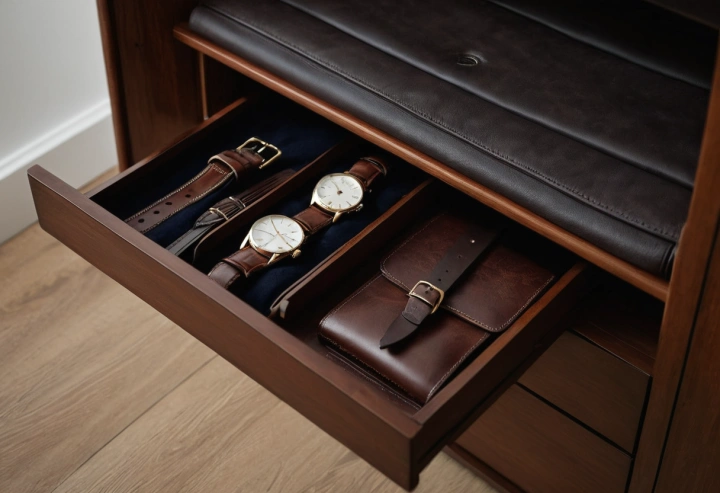
Allocate each person a defined territory: a drawer, a shelf, a door rail, a labelled box. Not a share of a communal accessory drawer. A whole container that is theirs, however modest. A man with two belts, a cardholder and a pair of sunglasses needs one shallow drawer and nothing more; the compact approach in our article on a men’s wardrobe corner scales down neatly to a single shelf.
Label discreetly. A small card in a holder, a strip of tape inside the drawer lip, a name written on the underside of a box lid. The label is not for the owner, who knows where their things are. It is for everyone else, including whoever puts the laundry away.
Children and teenagers can manage a rolling system for scarves and a single tray for small items long before they can manage a hanging system. Start them with one box each and let the box be the rule.
Shared items, the household’s spare straps and neutral pouches, live in one clearly marked communal box at the edge of the zone map, not scattered among personal drawers.
Where to start this week
Empty every accessory out of the wardrobe onto a bed. All of it, from every person. Group by category first: scarves together, straps together, charms together, pouches together. You will immediately see duplicates and orphans, and the orphans are the interesting pile: each needs either a bag to be reunited with or a decision to let it go.
Then assign methods: hang the silk, roll the wool, coil and box the straps, tray the charms, nest the spare pouches. Only then divide by person and label.
Buy nothing yet. Most households already own enough boxes and trays to run this system for a year. Live with the layout for a few weeks and notice what you reach past. That reach tells you what to move to eye level, and it is a better guide than any plan drawn on paper.
- Words
- Rail & Shelf editors
- Published
- Section
- Dressing Rooms
- Standards
- Editorial policy · Corrections